
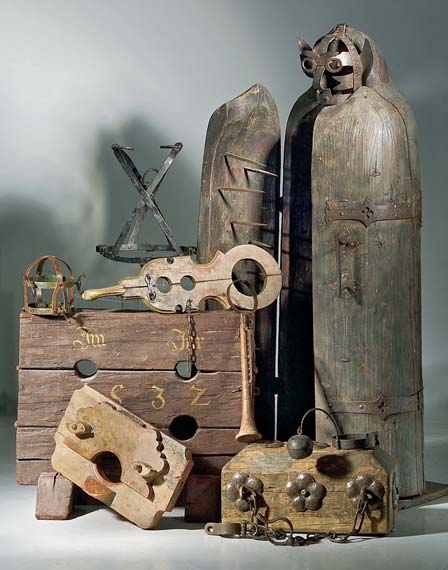
Was the Iron Maiden ever actually used? Despite its terrifying reputation, there is no credible evidence that the iron maiden was used as a medieval torture device. The familiar spiked cabinet appears to have been invented much later, during the 19th century.
The iron maiden is probably one of the most famous medieval torture devices of all time. So, it might surprise you to learn that it was never actually used in the Middle Ages. It was supposed to be a metal cabinet, slightly larger than a person. It was said to be cast in the shape of a woman, hence the term “maiden”. Inside were purported to be long spikes. As an item of torture, the victim was said to be locked inside the casket. It was too small to allow them to sit down, and they had to remain upright, but the spikes meant they couldn’t lean against the sides without being impaled. If left inside for long enough, the victim could die. Some versions were said to have spikes that could be extended to kill the victim.
The only problem with all of this is that such a device never existed in the Middle Ages. The first mention of the iron maiden comes from a mid-18th-century writer called Johann Georg Keyssler, a German polymath and travel writer. He travelled widely and wrote travelogues as a series of letters. They were heavily censored because of the political climate at the time, but they were published in several volumes. It is in his volume, “Travels through Germany, Bohemia, Hungary, Switzerland, Italy and Lorraine,” that he makes reference to the iron maiden. His travel accounts were first published in German in 1740 and 1741 and later translated into English in 1756 and 1757. He talked about a device called an iron maiden in Plassenburg Castle in Germany and the White Tower in Prague. However, he hadn’t seen the device, and he didn’t believe it existed. He said there was no evidence of it.
Another account appeared in a historical collection called Materials for the History of Nuremberg, published beginning in 1792. The collection was compiled by a German scholar named Johann Christian Siebenkees, although the iron maiden story is sometimes attributed to his cousin, Johann Philipp Siebenkees. The device that Siebenkees described, though, is a little different from the idea of the iron maiden that we have today, and he was probably confusing the purpose of a contraption that did actually exist. The device he describes is a metal cabinet that the person is put into. The person is then cut with swords, which is where the spikes idea comes from. He may have been writing about a device called a Schandmantel, or cloak of shame, that actually did exist. It was a wooden, barrel-like structure that people were trapped in and displayed. They were used for public humiliation more than torture, in the same way the stocks were. They had no spikes in them. However, Siebenkees also didn’t completely believe the account he read.
So, if the two people who wrote about the iron maiden in the 18th century didn’t really believe it, where did we get the idea that the iron maiden was a medieval torture device from? In the late 18th and early 19th centuries, there was a growing interest in Gothic fiction, mysterious castles, secret tribunals, and gruesome medieval punishments. People loved reading about them, and they loved going to see them. There was a new Gothic tourism, and various collections and displays emerged to meet this market. And this seems to be where the first iron maiden came from. The medieval crime museum in Rothenburg has an iron maiden that appeared to be from the 15th century. However, when they examined it more closely, they discovered it was a real Schandmantel with French bayonets from the Napoleonic era attached to the inside. This proved that the deadly spikes were a much later addition. The original device had been used for public humiliation, but someone had subsequently transformed it into an apparent instrument of torture.
In the 1850s, an antiques dealer and collector named Georg Friedrich Geuder assembled a collection of historical punishment instruments, including an iron maiden, which he displayed in Nuremberg Castle. The exhibition helped establish the iron maiden’s reputation as an authentic medieval device. Later, other iron maidens appeared in collections and exhibitions across Europe and beyond. In 1893, a collection of supposed torture instruments from Nuremberg Castle was exhibited in America, complete with an iron maiden. A year later, Bram Stoker, the author of Dracula, published a short story called The Squaw, in which an iron maiden played a central role. The device had become firmly established in the public imagination. And this is what I learned today.
Sources
https://en.wikipedia.org/wiki/Iron_maiden
https://www.history.co.uk/articles/the-iron-maiden-medieval-torture-device-or-modern-myth
https://allthatsinteresting.com/iron-maiden-device
https://en.wikipedia.org/wiki/Johann_Philipp_Siebenkees
https://en.wikipedia.org/wiki/Johann_Georg_Key%C3%9Fler
image By epbechthold – de.wikipedia epbechthold, CC BY-SA 3.0, https://commons.wikimedia.org/w/index.php?curid=790235