
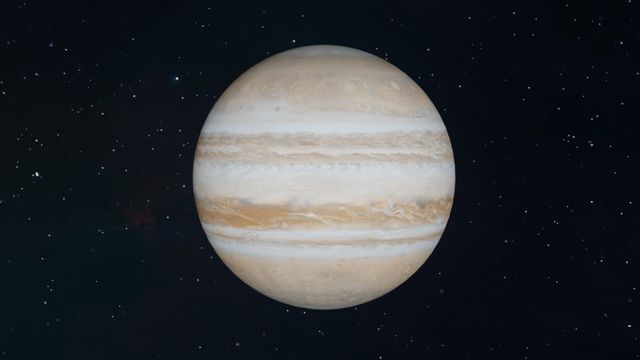
How deep could a space probe travel into Jupiter? No one knows for sure, but a space probe using modern materials could possibly get several hundred kilometers into Jupiter’s atmosphere before being destroyed by the enormous pressure and heat.
The only probe that has been launched into the atmosphere of Jupiter was the Galileo probe in 1995. It was flown to Jupiter aboard a larger spaceship and then dropped into Jupiter’s atmosphere. It used a parachute to slow its descent. The spacecraft left Earth in 1989 and took nearly 6 years to reach Jupiter. The Galileo probe was released when the spacecraft was still 80 million kilometers away. The probe flew to the planet and then began to descend. It was able to send a radio signal back to its mothership for 58 minutes, and its transmitter sent a signal for 61 minutes before contact was lost. The probe had reached a depth of 146 km by this time, and the pressure and heat were too much for its electronics. The body of the probe probably lasted a little longer, but it wouldn’t have been long before it was crushed and melted. 146 km on Earth would take you most of the way through the atmosphere and down to the surface, but on Jupiter it was only 0.22% of the planet’s radius. Almost nothing.
So, how deep could we send a probe? Whatever we built would need to be able to withstand high pressure, high temperature, and strong winds. We could probably send a probe a lot deeper than the Galileo probe, but nothing we could ever build would be able to get very far because of the way the pressure and temperature increase with depth.
The first problem to overcome would be the heat. The first region of heat is before the probe even reaches the cloud tops of the planet. Jupiter has a very strong magnetic field that accelerates charged particles toward the poles. These charged particles produce spectacular auroras, but they also heat up the upper atmosphere to roughly 420℃. That temperature is not too high and shouldn’t prove a problem for probe designers.
The probe will also have to be able to survive the incredible heat from the deceleration. The probe will be hitting Jupiter’s atmosphere at 170,000 km/h and will be moving so fast that the gas in front of it won’t be able to get out of the way. The gas will be compressed and will heat up to approximately 16,000 degrees Celsius.
Then the probe will enter the clouds and the fun begins. In the beginning, it will be very cold. We have gone from 420 degrees, and we drop down to roughly -150℃. Any probe is going to need to be able to cope with the change in temperatures. It won’t be cold for long, though, because the heat builds as we go down.
Once the probe enters Jupiter’s lower atmosphere, it will also have to contend with powerful winds. Astronomers have measured winds reaching approximately 1,450 km/h in parts of Jupiter’s stratosphere near its poles. Wind speeds vary enormously with altitude and location, so our probe might encounter very different conditions depending on where it enters. The probe would need to withstand the forces created by these winds while continuing its descent. As long as the probe doesn’t have any sensors or things sticking out, it should be ok.
As the probe continues to descend, the pressure and the heat both increase rapidly. It is a race to see which destroys our probe first. The pressure starts off bearable, but gets higher at an increasing rate. On the cloud tops, it is 1 bar. 13 km down, it is 1.6 bars. 54 km in and we are at 5 bars. 146 km, and we have reached 22 bars. 22 bars is a withstandable amount with modern technology. The pressure at the bottom of the Mariana Trench is 1,100 bar, and there are submarines that can survive that. We could probably make something that could withstand more than that. The problem comes because of the heat. The atmosphere heats up along with the pressure. It was 156℃ where Galileo vanished. If we go to a pressure of 100 bar, the temperature is 500℃, and over 1,000℃ as we reach 1,000 bar. To survive the pressure, the probe needs to have perfect hull integrity, but the heat will make the metal expand and warp. Many metals weaken as they get hot. It would also be impossible to insulate the electronics inside the probe from such heat. And as the heat rises, all of the sensors will fail. A cooling system could be included, but it would need power, and it would need somewhere to dump the heat.
NASA engineers have studied probes that could descend approximately 250 kilometers below Jupiter’s one-bar pressure level, where temperatures might reach 500°C and pressures could reach 100 bar. There is no established maximum depth for a future probe, but going much farther would require increasingly sophisticated materials, insulation, and electronics. Even at 250 kilometers, though, we would have penetrated less than 0.4% of Jupiter’s radius. We might have built one of the toughest spacecraft ever made, but we would still have barely scratched the surface. And this is what I learned today.
Sources
https://en.wikipedia.org/wiki/Exploration_of_Jupiter
https://www.missionjuno.swri.edu/legacy/atmospheric-sciences_galileo
https://en.wikipedia.org/wiki/Atmosphere_of_Jupiter
Photo by Zelch Csaba: https://www.pexels.com/photo/planet-jupiter-12498752/