
When did people discover that electrons carry electricity? People generally discovered that electrons carried electricity at the very end of the nineteenth century and the start of the twentieth.
Electricity is a collection of phenomena involving electric charges. One of these is electric current, which is the movement of electric charge through a material. There are several different ways that electricity can be transferred, but in the copper wires that are powering the computer I am writing this on, the electricity is transferred by electrons. However, the electrons themselves don’t rush through the copper wire. In copper wires, there are electrons that can move through the metal. When a voltage is applied, an electric field causes these electrons to move in an organized way, producing an electric current. The electrons themselves drift very slowly, but the electrical signal travels through the circuit at a significant fraction of the speed of light. Just like if you have a tube packed full of marbles. When you push on the marble at one end, another marble pops out at the other end, but it is not the same marble. The force has been transferred through all of the marbles, much faster than they can move themselves.
The interesting thing about electrons and electricity is that people have been using electricity and studying it for centuries, without knowing what caused it. Ancient Egyptian texts talked about electric shocks from fish, such as electric eels. In Ancient Greece, people with headaches were encouraged to touch these fish. Thales of Miletus, a Greek philosopher, studied static electricity in 600 BC. He rubbed pieces of amber with silk, but he thought the friction was making the amber magnetic. The Greek word for amber was “elektron”. Other people in Ancient Greece continued to look into static electricity, but then the study of electricity faded away for almost two thousand years.
The study of electricity was picked up again by Girolamo Cardano, an Italian mathematician and physician in 1550. He talked about the differences between the attraction produced by charged amber and that of magnets. Then, our story takes off again with William Gilbert in 1600. He tested many different materials to see if they could attract objects, too. He discovered that many materials exhibited the same properties when rubbed. He developed an instrument called a versorium, which was a lightweight pivoting needle used to detect electrical attraction. He used the Latin word electricus to describe this attractive property. His method was very experimental, and the new emerging field of experimental scientists became interested, and electricity became something to study again. In 1646, another English physician and writer, Thomas Browne, introduced the word electricity in his book Pseudodoxia Epidemica, but nobody knew about electrons.
Then, in the 1830s, Michael Faraday discovered the important relationship between electricity and chemistry. He was working with electrolysis, and he discovered that the amount of change in the chemicals depended directly on the quantity of electricity passing through the material. This was a clue that electricity must have distinct units rather than being something amorphous. Faraday’s work was vital, but he didn’t discover electrons or establish that electric currents in metals were carried by them. Then, in 1874, an Irish physicist called George Johnstone Stoney proposed that there was a fundamental unit of electric charge. In 1891, he called it the electron. He didn’t discover the electron, and he never saw one, but he knew that electric charge must have a quantity.
The biggest breakthrough came in 1897, when a British physicist named J. J. Thomson discovered that cathode rays consisted of tiny negatively charged particles, much lighter than atoms. He was working with cathode rays, which are a glow produced inside glass tubes with very little gas inside them. We know now that the glow is caused when electrons interact with the gas. Thomson used electric and magnetic fields to deflect the rays, which led him to his discovery. He called the electrons corpuscles, but they were later renamed electrons.
Then, in 1900, a German physicist called Paul Drude developed a theory of electrical conduction in metals. He proposed that metals contained mobile negatively charged particles that could move through the material and carry the electrical current. His theory became known as the Drude model, and it identified electrons. Drude had identified electrons, but he never saw one. In 1911, C. T. R. Wilson made a cloud chamber that made it possible to observe the tracks left by charged particles. The electrons ionized the gas, which attracted water molecules and left a trail. He won a Nobel Prize for that. And this is what I learned today.
Sources
https://www.saveonenergy.com/resources/history-of-electricity
https://www.eia.gov/kids/history-of-energy/timelines/electricity.php
https://en.wikipedia.org/wiki/Electricity
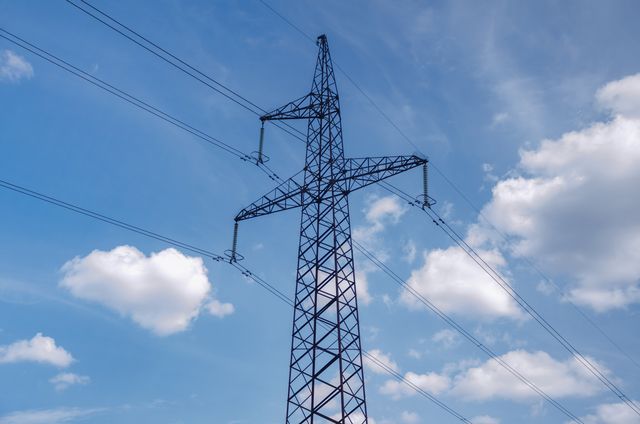
Photo by Ola Noland: https://www.pexels.com/photo/high-voltage-transmission-tower-against-blue-sky-37588458/