
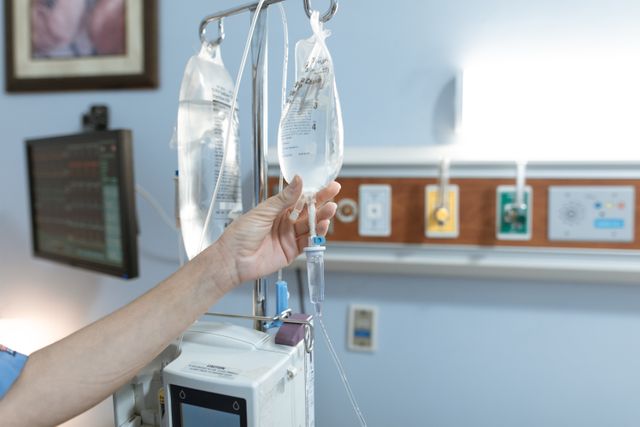
Is an air bubble in an IV dangerous? An air bubble in an IV can be dangerous, but it depends on how much air there is and how quickly it is introduced.
We have all seen movies where people are killed when someone injects an air bubble into their IV line. But is this actually something that can kill people? It turns out that it can, but it depends on the size of the person, the amount of air injected, and how quickly it is injected. The size of the air bubble also depends on whether it is in the veins or in the arteries. There is no exact amount of air that is guaranteed to be fatal. Medical studies often cite 3 to 5 mL of air per kilogram of body weight as a potentially lethal amount when it enters a vein rapidly. For a 70 kg person, that would be approximately 210 to 350 mL. Much smaller quantities can sometimes cause serious complications, depending on where the air travels and the patient’s condition. However, an air bubble in an artery can be dangerous at a fraction of that size.
An IV line is inserted into a vein, hence the name Intravenous. Veins carry blood that has had most of its oxygen removed to the right side of the heart so that it can be sent to the lungs and reoxygenated. Once it has been reoxygenated, the arteries carry it to the organs, where the oxygen and other things are removed from it, and the veins carry it back. That means any air injected into an IV is going to be carried to the right side of the heart and then passed on to the lungs.
Small quantities of air entering the veins can sometimes be removed naturally by the lungs. Our bloodstream is able to absorb some air and pass it to the surrounding tissue. And once the air bubble goes through the heart and enters the lungs, it may become trapped there and will pass out of your body through the lungs when you breathe. The lungs act as a filter, and the bubbles get trapped, dissolving into the lungs and being released. The lungs can remove a fairly large quantity of air from the lungs, which is why the veins can cope with so much. However, if it enters the blood very quickly, it can block the heart. It can interfere with the heart’s ability to pump blood and obstruct blood flow to the lungs. If that happens, it can be serious.
However, it is in the arteries where problems can really form. If a quantity of air that is too large for the lungs to remove gets pumped into the blood through an IV, some of it can pass into the arteries. The arteries carry blood directly to organs, including the brain, and this is where an air bubble can become serious. Any bubbles in the arteries can get stuck at the site where the blood joins an organ and block it, cutting off the blood supply. If this goes on for long enough, it can cause significant damage. Even a small amount of air in a critical artery can cause serious damage. And the arteries feed blood to the brain as well. A blockage into the brain can cause irreparable damage, even death. This is called an air embolism.
What can be done if an air bubble is spotted? If it is spotted in the IV tube, the nurse or doctor just has to stop the IV. Modern IV drips actually have an air-in-line sensor that will automatically stop the IV if it detects air. If a small bubble has entered the vein, the medical staff will probably leave it, but monitor the patient. If the air has reached the arteries and the patient is showing signs of an air embolism, the medical staff will stop the source of the air. And then they will administer 100% oxygen to the patient. This is interesting because it does two things. Firstly, the air in the air bubble will have 78% nitrogen. When you add pure oxygen to the patient’s blood, it lowers the concentration of nitrogen in the blood, and the nitrogen in the air bubble will diffuse out into the blood, shrinking the bubble. The second thing is that the extra oxygen will help where the blood supply was cut off. If that doesn’t fix things, the patient will be placed in a hyperbaric oxygen chamber. In such a chamber, a patient can breathe 100% oxygen, and the inside of the chamber is kept at a pressure greater than atmospheric pressure. This pressure compresses the air bubbles, making them smaller and easier to pass. This treatment is also used when divers suffer from the bends. It removes the excess nitrogen from their bodies. And this is what I learned today.
Sources
https://my.clevelandclinic.org/health/diseases/air-embolism
Photo by RDNE Stock project: https://www.pexels.com/photo/person-monitoring-a-dextrose-6129691/