
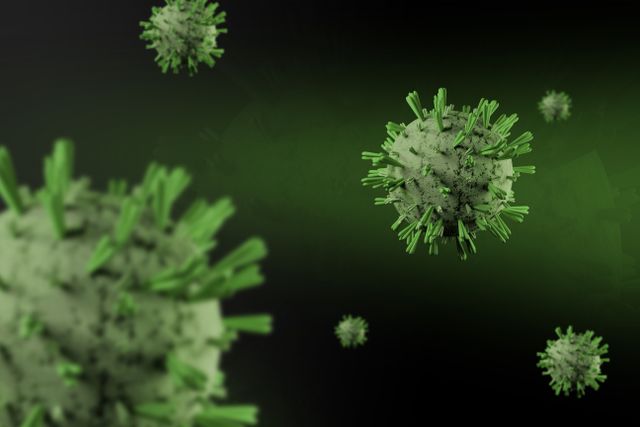
How did we discover viruses? Viruses were first theorized in the 1890s, but they wouldn’t be seen until electron microscopes were invented in the 1930s.
The word virus comes from Latin and originally meant poison or poisonous liquid. It entered English in the late 14th century and was used by physicians to describe infectious or poisonous substances. By the 18th century, it was sometimes used for material discharged from infected wounds. Its modern meaning developed during the 19th century and became more specific when scientists began investigating previously unknown infectious agents in the 1890s.
Bacteria were discovered long before viruses because they are visible through a light microscope, while viruses are not. Ordinary light microscopes use visible light to magnify objects. However, because light travels in waves, there is a limit to how much detail these microscopes can resolve. For a conventional light microscope, that limit is roughly 200 nanometers. Most viruses are smaller than this, although bacteria are generally large enough to be seen. There are some large viruses, but they are rare. Bacteria vary in size depending on the type, but they tend to be 500 to 5000 nm, easily visible through a light microscope. That is why they were first observed at the end of the 17th century by a draper and microbiologist called Antonie van Leeuwenhoek. He earned a living selling cloth, but he had a fascination with microscopes, and he started to make his own, refining the lenses. He was able to see tiny moving organisms in rainwater and dental plaque, which he called animalcules, but they were bacteria.
Viruses couldn’t be seen through ordinary microscopes, which made studying them difficult. Scientists could demonstrate that an invisible infectious agent existed, but they couldn’t examine its physical structure. That wouldn’t become possible until the development of electron microscopes in the 1930s.
The first person to notice the existence of viruses was a Russian biologist called Dmitri Ivanovsky in 1892. He was working with an infectious disease called Tobacco Mosaic Disease. It is caused by a virus that infects a wide range of plants, especially tobacco. It causes a characteristic mosaic pattern on the leaves, hence its name. Ivanovsky wanted to test if the disease was caused by bacteria, so he used a filter called a Chamberland filter, designed by a French microbiologist called Charles Chamberland. It had holes that were small enough to catch bacteria. Ivanovsky used the filter to filter the sap from an infected plant and he discovered that the resulting liquid was still able to infect plants. He reasoned that the disease was either being passed on by bacteria so small that they could pass through the filter, or by toxins the bacteria had produced. He didn’t know it, but he had found viruses.
A Dutch microbiologist called Martinus Beijerinck repeated the experiment in 1898, and he became convinced that the filtered liquid from the tobacco plant contained a new form of infectious agent. When the filtered sap was introduced to healthy plants, the disease began to multiply again, and he reasoned that bacteria or toxins wouldn’t cause this. He didn’t know what he had found, but he gave the new infectious agent the name “virus”. In the same year, two German microbiologists passed the first animal virus through a filter and discovered that foot and mouth disease was also caused by something that could pass through the filter.
Discoveries began to increase. In 1900, Walter Reed showed that yellow fever was transmitted by mosquitoes and an infectious agent that could pass through a filter. The similarities among all these diseases were starting to mount up. In 1908, Karl Landsteiner and Erwin Popper showed that polio could be caused by something that could pass through a filter. In 1915, Frederick Twort discovered a mysterious infectious agent that could pass through a filter and destroy bacteria. Then, in 1935, an American biochemist called Wendell Stanley managed to purify and crystallize the tobacco mosaic virus. This meant scientists could study the infectious agent and, amazingly, when it was dissolved, it was still infectious!
The electron microscope was invented in 1931 by Ernst Ruska and Max Knoll. Unlike ordinary microscopes, it used electrons rather than visible light, allowing scientists to see much smaller objects. In 1938, scientists produced some of the first electron-microscope images of viruses, and in 1939, researchers finally photographed the tobacco mosaic virus. They could see the individual rod-shaped particles responsible for the disease, 47 years after Ivanovsky had first discovered evidence of their existence. And this is what I learned today.
Sources
https://www.britannica.com/story/how-were-viruses-discovered
https://en.wikipedia.org/wiki/History_of_virology
https://www.vinmec.com/eng/blog/who-first-discovered-the-virus-en
https://www.etymonline.com/word/virus
https://en.wikipedia.org/wiki/Antonie_van_Leeuwenhoek
https://en.wikipedia.org/wiki/Germ_theory_of_disease
https://en.wikipedia.org/wiki/Bacteria
https://en.wikipedia.org/wiki/Tobacco_mosaic_virus
Photo by Daniel Dan: https://www.pexels.com/photo/close-up-photo-of-a-corona-virus-7542650/