
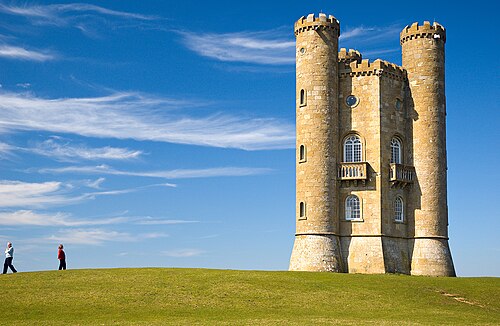
What is a folly? A folly means something foolish, without lack of good judgment, foresight, or normal prudence. We are looking at architectural follies and they are the same, but with buildings. A folly is a building that was built solely for decoration rather than for purpose.
Rich people have always built follies. If someone owns a lot of land and has a lot of money, they can build whatever they want on it. However, the idea of architecture for the sake of decoration or for entertainment seems to have become common in the late 18th century. At this time, there was a romantic uptake in the idea of the ancient world. There was also a lot of new wealth being created by the Industrial Revolution. People who had been rich for generations probably felt less need to flaunt their wealth. People who had just become wealthy wanted to erect buildings that they believed improved their land aesthetically rather than practically. A lot of follies were copies of ancient temples or ruins, but many of them were newly created buildings. Here are a few examples.
Wainhouse Tower on the south-west side of Halifax, UK. It is known as the tallest folly in the world, or the Tower of Spite. It was built by John Wainhouse. He owned a dye works in a valley. Halifax had just changed its smoke laws to say that all factories that produced smoke needed to have a chimney tall enough to carry it away. Because his factory was in a valley, his chimney needed to be very tall. After the chimney was half finished, Wainhouse sold the dye works, but the new owner refused to pay to finish the chimney. Wainhouse decided to keep the chimney and turn it into a tower with viewing platforms. It was very elaborately decorated. Wainhouse was also involved in a bitter feud with his neighbor, Sir Henry Edwards. This led to stories that he completed the tower so that he could look down onto Edwards’s estate, earning it the nickname the “Tower of Spite.” Whether annoying his neighbor really influenced Wainhouse’s decision to finish the tower isn’t known.
Another famous folly is the Dunmore Pineapple in Scotland. John Murray, the 4th Earl of Dunmore was having a summer retreat built in his gardens in the late 18th century. The building was attached to hothouses where exotic fruit was grown. Pineapples had first arrived in England in the 17th century, and by the 18th century some wealthy estates, such as the Earl of Dunmore’s, had begun to cultivate them. They were still very expensive and a sign of wealth and prestige. To show this, the Earl had a three-story stone pineapple built on the roof of his summer retreat.
Another excellent example of a folly tower is Farringdon Folly in Oxfordshire, UK. It was built by Lord Berners in 1935. He was a very eccentric composer, novelist, and painter. He was friends with many famous artists of the day. He decided to build a 35 meter high tower on top of a hill. One of his main reasons was, apparently, to annoy his neighbors. When the tower was finished, he gave it to his friend as a birthday present.
Let’s finish with a couple of castle follies. The 6th Earl of Coventry owned Croome Court, near Broadway, in the UK. He decided that one thing his grounds needed to make them look better was a castle on a hill. His architect put together turrets, battlements, balconies, and gargoyles, to make a vaguely medieval looking castle. He even imported dark stone to make the building look old. From a distance it does look like a castle on the hill, but when you get closer, it looks like a very squashed up toy castle.
And then there is Sham Castle in Bath, UK. It was built for exactly the same reason. Ralph Allen, a merchant in the late 18th century, looked out of his house and thought that the view would be improved if there was an ancient castle on the hill. So, his architect built the front of a castle, and nothing behind it.
Britain has a lot of follies, but it is not the only country to have them. France has fake buildings and even a fake village commissioned by Marie Antoinette. Germany has fake ruined castles that were built in the 18th and 19th centuries as ruined castles. And America has its fair share of European or Greek and Roman style buildings. If people have enough money, there is nothing they can’t build. And this is what I learned today.
Sources
https://en.wikipedia.org/wiki/Folly
https://dictionary.cambridge.org/dictionary/english/architectural-folly
https://en.wikipedia.org/wiki/Wainhouse_Tower
https://www.faringdonfolly.org.uk
https://en.wikipedia.org/wiki/Sham_Castle
Image By Newton2, CC BY 2.5, https://commons.wikimedia.org/w/index.php?curid=1946225