
How did ancient people move stone blocks? Ancient people had several methods to move enormous stone blocks. They could use water, wooden sledges, wooden rollers and levers, ramps and earthworks, scaffolding, machinery, or just by walking them.
When we look at some of the monuments by people of the ancient world, it can make us wonder how they were able to move such enormous blocks of stone. Some of the largest stones ever moved by ancient people are the Ramesseum Colossus. It is a gigantic statue of Ramesses II, now broken up, that would have weighed about 1,000 tons. It was moved roughly 270 km. Three limestone blocks weighing about 800 tons were moved by the Romans and installed on a temple podium. And the Colossi of Memnon, two statues of Amenhotep III, weighing about 720 tons each, were moved about 675 km in Egypt. Then, more modern, but still without machinery, the Thunder Stone, a 1,500 ton rock was moved in Saint Petersburg in 1760. It was used as the pedestal for a statue of Peter the Great.
One of the easiest ways to move a large block is by boat. Once the block was on the boat, even a monster of 1000 tons, it would float, provided the boat was large enough. The Egyptians dug canals to get the boats as close to where they needed the stones as possible. When the pyramids were built, there was a branch of the Nile that reached much closer to where the pyramids are. This has long since disappeared.
Once the blocks were on boats, but getting them from the quarry to the boat and from the boat to wherever they were needed was not so easy. One method was to use wooden sleds. A giant sled pulled by people over sandy desert could move a surprisingly large amount of rock. And by dampening the sand in front of the sled with water, it reduced friction and the sled moved even more easily. The water binds the sand grains together and stops the sand from piling up in front of the sled. Modern experiments have shown that eight men pulling on a sled can move 2 tons and 45 men could move 16 tons.
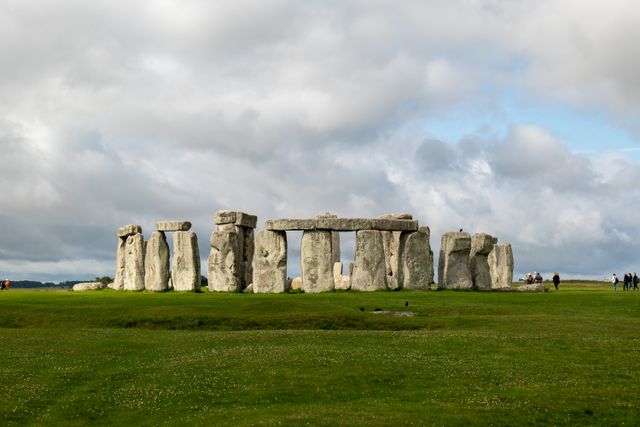
Over land that didn’t have canals or sand, rollers were a good option. This is one of the ways researchers think giant cut rocks were brought from the quarries to Stonehenge. A wooden sled on a line of tree trunks would roll fairly easily, and the trunks could be continuously moved from the back to the front as the sled moved. The Thunder Stone was apparently dragged over bronze spheres along a track. The spheres acted like ball bearings and the stone was easy to move, once it had been started.
Some rocks were walked to their location. The massive rocks that were used to make the moai on Easter Island were walked from the quarry to their resting place. The rocks were stood up on end and then rocked from side to side using ropes. The hardest part is starting the statue rocking, but once it is going, it is very easy to keep it going. A group of modern archeologists tried the process with a 5 ton replica and a team of 18 people. They were able to walk their statue 100 meters in 40 meters. If this is the method they used on Easter Island, they could probably have walked a statue across the island in a couple of weeks.
With constructions like the Great Pyramids and many temples, getting the huge blocks there was only half of the problem. Getting them on and off the ships, or in place on the building, was far more difficult. Some buildings were built using ramps. It is thought that this was how the pyramids were constructed. An earth ramp that zigzagged up the pyramid would have made it fairly easy for workers to maneuver blocks up, so long as the incline wasn’t too steep.
Some blocks were maneuvered using scaffolding and levers. Workers used a lever to lift one end of the block, and wooden scaffolding was inserted. Then they would lift the other end of the block, and scaffolding was inserted. By repeating this process, the scaffolding would slowly raise the block up to the required height.
The Romans also used pulleys and cranes to lift heavy blocks. The ancient Greeks used wooden cranes with a treadwheel. The Romans took this technology and improved upon it. Wood is surprisingly strong in compression, and when several people are walking the treadwheel, a lot of force can be applied. The Romans also used systems of pulleys, which reduced the amount of force required to lift heavy objects. The advantage depended on the number of rope sections supporting the load. If a six-ton block was supported by twelve sections of rope, the pulling force would theoretically be reduced to the equivalent of 500 kg. However, this comes with a trade-off. To lift the block one meter, the rope would have to be pulled twelve meters. In practice, friction would increase the force required. Using pulleys and different types of frame cranes, the Romans were apparently able to lift blocks that weighed 100 tons. That is very impressive, and this is what I learned today.
Sources
https://en.wikipedia.org/wiki/Construction_of_the_Egyptian_pyramids
https://www.ling.upenn.edu/~jason2/papers/pyramid.htm
https://en.wikipedia.org/wiki/Baalbek_Stones
https://en.wikipedia.org/wiki/Bronze_Horseman
https://en.wikipedia.org/wiki/List_of_largest_monoliths#Moved_monoliths
Photo by Eren Cebeci: https://www.pexels.com/photo/stonehenge-against-a-cloudy-sky-wiltshire-england-18222640/