
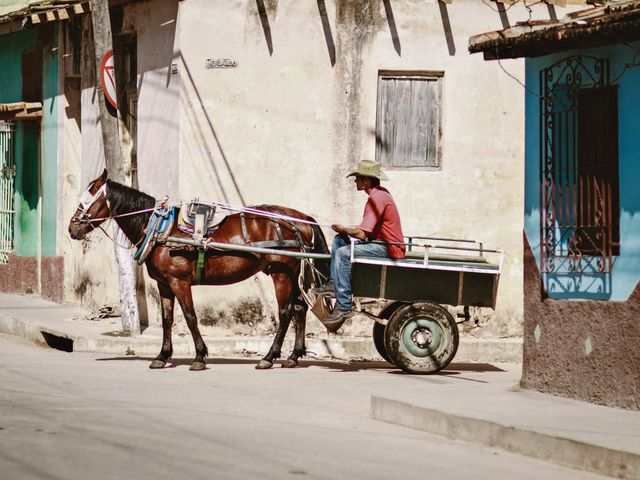
Where did all the horses go when the car was invented? The car was invented and introduced overnight, so the number of horses in any country was slowly reduced over time. The number of horses in most countries peaked just before 1930 and then began a relatively rapid decline.
Before cars were introduced, almost every type of vehicle was horsedrawn. Some rudimentary bicycles were invented in early 19th century, but they were not really a replacement for horses. Any vehicle that carried a load was pulled by one or more horses. Up until the 9th century, roughly, they had been pulled by oxen. The only type of yoke to pull a cart went over the throat of a horse, so they couldn’t pull very hard because they choked themselves. Oxen didn’t have that problem because of the thick muscle on their necks. However, oxen can’t walk that far, are difficult to control, and are slow. The horse collar, introduced from China, moved the load from the horses throat to the muscle at the top of its chest and made it possible for them to exert more power. Horses can pull further and faster than oxen. Horses are easier to control and they can also be ridden to work. The horse collar meant that farmers no longer needed to live on their farms and helped villages grow. They also started the gradual increase in the number of horses that would last almost the next 1,000 years.
There is no way to reliably say how many horses there were worldwide in any given year because records weren’t kept. It is probably safe to say that they increased in line with the population increase and the agricultural improvements in any country. More people and more food being produced probably means more horses to work the land and more horses to transport goods. And this probably led to an increase in different types of trade, which would have led to an increase in non-agricultural goods being transported. And the increase in wealth would probably have led to more people traveling, which would also have needed more horses.
Once we get to the Industrial Revolution and cities start to increase in size, we have a sudden uptake in the number of horses used within cities. They were used to transport goods and resources between factories, and they were used in places like coal mines to bring the coal out. The life of a horse was a hard one. In the city, by the early 19th century, hansom cabs are becoming more popular and horses are needed for those as well. It is estimated that in London in 1900 there were more than 300,000 horses in the city alone. And these horses produced problems and a whole industry of their own. Horses produce a lot of manure that someone needed to get rid of. And they needed to be fed and cared for, as well. The horse traffic in London was so bad that people were as worried about congestion, collisions, accidents, pollution, and safety hazards as they are today. Horse traffic over certain areas, such as London bridge, was often restricted.
The car was invented in 1886 by Carl Benz, but it took a while before they became common. Just like any technology, in the beginning they were not that good and were very expensive. As more people used them, there was more money for research, and they slowly improved and came down in cost. The number of horses being used mirrors this drop in cost of the automobile. The number of horses hits a high from roughly 1910 until 1920. The main reason for this is World War 1. Automobiles were introduced in the war to transport soldiers and equipment, but they often weren’t powerful enough to cope with the conditions. Horses were much easier and cheaper to use. It is estimated that 8 million horses, mules, and donkeys were killed in World War 1, which means vastly more were being used.
After World War 1, cars and trucks became more reliable, cheaper, and able to drive greater distances. They slowly began to replace horses. They would have replaced horses in the cities first of all, but, for a while, horses and vehicles would have competed with each other. The advantages of cars over horses quickly became apparent, though, and horses disappeared from cities. Horses would have lasted longer in agricultural areas because farmers couldn’t always afford cars, but soon it became obvious that farmers using horses couldn’t compete and they would have been replaced by vehicles there as well.
All of the millions of horses weren’t taken away and shot. Because they were replaced over a couple of decades, the number of horses being bred was slowly reduced. It was basic supply and demand. And this is what I learned today.
Sources
https://www.ltmuseum.co.uk/visit/museum-guide/surface-1900-1945
https://en.wikipedia.org/wiki/History_of_horse-drawn_transport
https://en.wikipedia.org/wiki/Ox
https://www.rivm.nl/bibliotheek/rapporten/422514002.pdf?
https://en.wikipedia.org/wiki/Horses_in_World_War_I
Photo by Mehmet Turgut Kirkgoz : https://www.pexels.com/photo/horse-drawn-cart-in-town-19355764/