
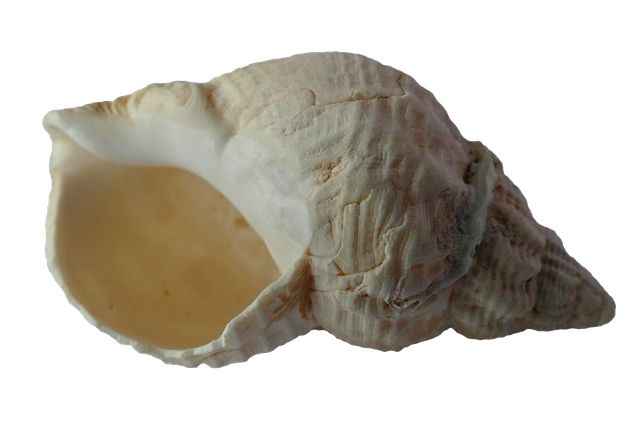
Why can you hear the sea when you hold a seashell to your ear? Well, obviously, you cannot hear the sea through a seashell. What you are hearing is a mixture of ambient sounds that have been merged into a mix of frequencies, just like the sounds that waves hitting a beach produce.
One thing you might often hear is that when you put a seashell to your ear, you are hearing the blood rushing in the capillaries around your ear. You can see how that is not possible if you think about two different things. Firstly, capillaries are much smaller than veins or arteries, and if they did make a noise, they wouldn’t make a lot of it. And second, if your blood were producing the sound you hear in a seashell, you would expect it to grow and subside as your heart pumps blood around your body, which it doesn’t. For a bonus third reason, it would get louder if you listened to a seashell while exercising, which experiments show that it doesn’t. That’s not to say that you can’t hear your own blood. You can. The inner and middle ear are not very far from major blood vessels, and if it is very quiet, you can hear a whooshing sound, especially after exercise or a lot of coffee. If it is quiet, you can also hear your own heart sometimes. Although the sound of a heartbeat is not the sound of the heart pumping blood, but the sound of the valves between the heart cavities closing to stop blood moving backwards.
So, what is the sound we can hear when we put a seashell to our ear? The sound you hear is the ambient noise resonating inside the seashell. Resonance is when a material vibrates at a particular frequency. You might remember it from when we looked at why soldiers have to break step when they march over a bridge. If the frequency of their steps matches the structural resonance, or natural frequency, of the material in the bridge, it can be shaken apart. It is the same thing that happens when an opera singer shatters a wine glass. It is also the same thing that happens when you get a musical note out of a wine bottle by blowing air across the top of it.
When ambient noise enters a seashell, it contains a mixture of many different frequencies. The sound waves reflect off the hard inner surfaces of the shell. Because of the shell’s shape, some frequencies cause the air inside to resonate more strongly than others. This makes those frequencies louder, while other frequencies are reduced. Different shells have different shapes and sizes, so they resonate at different frequencies. Unlike a wine bottle, which produces a relatively clear musical note, the irregular shape of a seashell can reinforce several frequencies at once. The resulting mixture creates a rushing sound that resembles waves washing onto a beach.
The size and the shape of the shell affect how much it resonates and at which frequency. The frequency at which the shell resonates increases the level of the same frequency in the noise around and makes it louder. The sounds mix, making a sound that is similar to the sound you get from waves on a beach. Many natural sounds, including waves, wind, and rain, contain a broad mixture of frequencies rather than a single musical note. The seashell filters background noise into a soft rushing sound. Our brains recognize its similarity to waves washing onto a beach. It isn’t only a shell. You can do this with any object you can hold over your ear and capture sounds in.
We can prove that the noise comes from outside the shell with a simple experiment. If you take a seashell into a soundproof room and hold it to your ear, you won’t hear the familiar rushing noise. The shell needs sound from the environment to produce the effect. Without any ambient noise, there is nothing for the shell to amplify. The sound also changes depending on where you are. In a noisy room, a shell may produce a louder rushing sound than it does in a quiet room. This is because there is more background noise for it to resonate with. If you take a seashell to a beach, you really might hear the ocean inside it, but only because the actual waves are part of the background noise! And that’s what I learned today.
Sources
https://en.wikipedia.org/wiki/Seashell_resonance
https://en.wikipedia.org/wiki/Reverberation
https://science.howstuffworks.com/question556.htm
Photo by Anthony 🙂: https://www.pexels.com/photo/white-conch-shell-157516/