
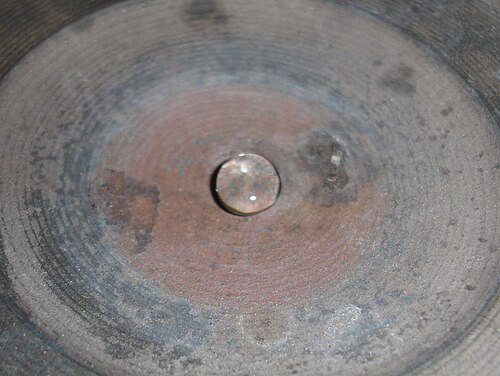
What is a Leidenfrost droplet? A Leidenfrost droplet is something that you may have seen in your frying pan. It is a drop of liquid, often water, that hovers and glides over the solid surface beneath it.
If you have a very hot, dry frying pan and you drop water into it, some of the droplets may become Leidenfrost droplets. You will be able to observe them moving around the pan. They will move fairly quickly and very smoothly, almost as though they are gliding. And you might be surprised how long the droplets survive in the pan without evaporating.
A Leidenfrost droplet forms a ball and hovers above the pan on a cushion of water vapor. It hovers about 0.2 mm above the surface of the pan. When the pan is hot enough, the bottom of the water droplet vaporizes the instant it comes into contact with the frying pan. This water vapor gets between the water droplet and the pan and becomes the cushion that the water droplet skates around the frying pan atop of.
The droplets last a lot longer than you might expect, and this is because of the temperature of the pan. If you drop water into a frying pan that is just above 100 ℃, the boiling point of water, the water will hiss and rapidly evaporate. The hiss comes from the water being rapidly turning into steam. However, increasing the temperature of the pan doesn’t increase the speed with which the water evaporates. At some temperature, approximately 193 ℃ for water, the water reaches the Leidenfrost point and stops evaporating. The bottom of it vaporizes, and it starts to slide around the pan. It doesn’t evaporate because of the water vapor. Steam is very bad at conducting heat. The frying pan is incredibly hot, but the steam slows down the heat being transferred to the water droplet floating above it. The water droplet is still above its boiling point, and it is evaporating, but much more slowly than the water that was spilled into the 100 ℃ pan.
The droplets appear to dance around the frying pan because of the way the water vapor is produced. It escapes unevenly, pushing the droplets in different directions. They can also be affected by the angle or slope of the pan and any scratches or imperfections in the surface. Experiments actually showed that droplets can be steered along a zigzag path cut into the surface of the pan.
Leidenfrost droplets and the Leidenfrost effect get their name from Johann Gottlob Leidenfrost, who was a German physician. He first studied and wrote about this phenomenon in 1756. The phenomenon carries his name, but a Dutch chemist and physician called Herman Boerhaave had actually written about it in 1732.
The Leidenfrost effect can be useful sometimes, but it also causes problems and has to be suppressed. You might not think it, but it is actually important if you want to stick your hand in molten lead. Lead melts at 327.5 ℃. Putting your hand in something that hot would instantly damage your hand. However, if you dip your hand in water first, you can quickly put your hand in molten lead and pull it out unharmed. That is because the lead is much hotter than the boiling temperature of the water, and it makes an instant layer of water vapor around the water on your hand. This slows down the transfer of heat, and you can pull your hand out unburned. It only works if you pull your hand out fairly quickly.
The Leidenfrost effect causes problems when water is needed to cool things down, such as in a nuclear power plant. If the temperature of the surface is too high, the Leidenfrost effect will happen, and the water won’t be able to cool down whatever it is being used on. To avoid this, it is possible to suppress the effect. One thing you can do is to make the surface rough. Tiny structures on the surface can allow the water to keep contact with the hot metal and give the steam a path to escape. You can also make the surface hydrophilic, which attracts water and makes it spread out, rather than forming droplets. An electric field will also suppress it. The electric field destabilizes the vapor layer, bringing the droplet into contact with the surface. And you can vibrate the surface. Strong vibrations disrupt the water vapor layer, bringing the water droplet into contact with the pan. These methods are used in industrial cooling systems where rapid cooling is necessary. And this is what I learned today.
Sources
https://en.wikipedia.org/wiki/Leidenfrost_effect
https://en.wikipedia.org/wiki/Johann_Gottlob_Leidenfrost
https://en.wikipedia.org/wiki/Herman_Boerhaave
Image By Cryonic07 – Own work, CC BY-SA 3.0, https://commons.wikimedia.org/w/index.php?curid=25460851