
Why do some plants generate heat? The plants that generate heat are called thermogenic plants, and they seem to do so for several reasons, most of which are connected to reproduction.
When we think of living organisms producing their own heat, we will probably focus on mammals. We are able to produce heat by using the energy we get from food, and we can keep our body temperatures at a stable temperature all the time. We get hotter when we exercise, and heat production goes into overdrive. We probably don’t think of the cold-blooded lizards, crocodiles, and snakes that are dependent on the warmth of their environment and can’t produce their own heat. But then there are birds, which are able to warm themselves, and they have been doing so since they diverged from dinosaurs. Fish can heat themselves as well. A lot of fish rely on the temperature of the surrounding water, but some fish can heat themselves with their swimming muscles. They warm certain parts of their bodies. And even insects can warm themselves. Insects that fly flap their wings so quickly that their flight muscles keep them warm. However, we very rarely think about plants warming themselves.
The vast majority of plants are at the mercy of their environment. If it gets cold, they slow down their metabolism, lose their leaves, produce antifreeze to protect themselves, or withdraw into a bulb. However, there are at least 90 species of plants that can produce heat. These plants don’t always do it to keep warm, but that is one of the reasons.
Thermogenic plants produce heat by burning stored sugars and fats through a process called cellular respiration. Plants usually break down sugars to produce energy that their cells can use, and they produce a molecule called ATP (adenosine triphosphate), which stores the energy for the plant to use at a later date. Thermogenic plants produce an enzyme called alternative oxidase, which allows the plant to skip some of the normal energy-producing steps. This means less energy is stored as ATP and more is released as heat. By breaking down large amounts of sugars and fats, the plant can produce a surprising amount of warmth. It tends to be large plants that produce heat because they have more volume to produce heat with.
So, the question is, why do they produce heat? There are two reasons. The first is that they are trying to keep warm. There is a plant called the Skunk Cabbage that can produce enough heat to keep itself warm when the outside temperature is lower than freezing. The Skunk Cabbage grows in the winter and pushes up through the snow. It can produce enough heat to keep its core at 22℃, while the air temperature and the snow around it is below freezing. Producing its own heat protects the reproductive structures from freezing and allows the plant to flower and reproduce earlier in the year than many other plants, giving it an advantage.
There is another theory that thermogenic plants produce heat to help pollinating insects, which, in turn, helps the plants to reproduce. Producing heat does three things. Firstly, the heat helps disperse chemicals called volatiles that attract insects. The Voodoo lily uses heat to spread a strong smell of rotting meat. The second reason is that the heat gives the insects a comfortable place to shelter. In the cold, insects are looking for food, but they are also looking for somewhere warm to shelter. A warm flower with food will have an advantage over a cold flower with food. And the third reason is that some insects can detect infrared radiation, which is emitted by warm objects. In 2025, scientists discovered that certain beetles can detect infrared radiation coming from thermogenic plants. The plants use this heat as a signal to attract the beetles, which then pollinate them. We can’t see it, but a warm flower will glow more clearly to an insect that can see infrared than a cold flower.
Evolution obviously doesn’t have to have a reason, but more often than not, something that confers a reproductive advantage is more likely to be passed on than something that doesn’t. Producing heat is costly for a plant because it requires energy, and if it didn’t produce an advantage, you would think that it would have been weeded out. And this is what I learned today.
Sources
https://en.wikipedia.org/wiki/Thermogenic_plant
https://www.kew.org/read-and-watch/hot-or-not-plant-heat-production
https://www.gardeningknowhow.com/garden-how-to/info/do-plants-produce-heat.htm
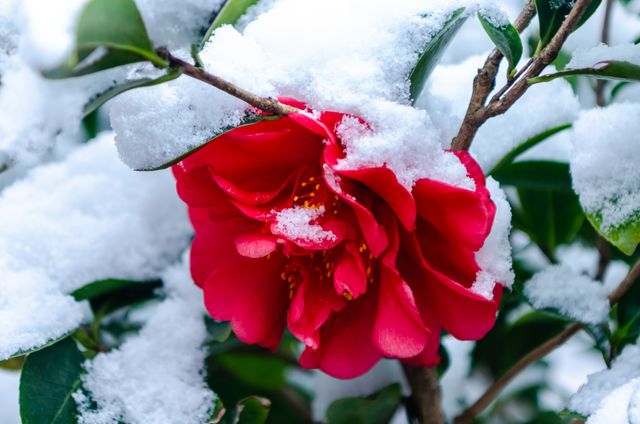
Photo by 高飞雪: https://www.pexels.com/photo/bright-red-camellia-flower-covered-in-snow-37413007/