
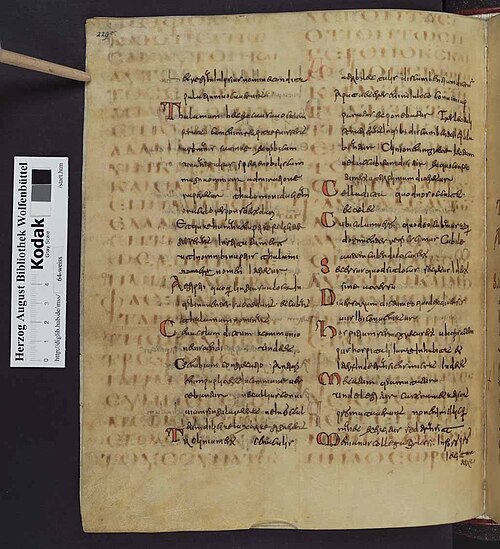
What is a palimpsest, and how can erased writing be read? A palimpsest is a piece of animal skin or parchment that has been written on, scraped clean, and then written on again. The original text that was scraped off can sometimes be read using multispectral imaging. The word palimpsest comes from the Greek palin, which means again, and psao, which means scrape.
Before paper, a variety of things were used to write on. Early civilizations used clay tablets or carved into wood or stone. Once the clay has hardened, or the wood or stone has been carved, they can’t be reused. Other people used wax tablets with a stylus to scrape letters into them. A wax tablet can be heated, smoothed, and reused, but there is no trace left of the writing that was there before. Other things to write on were paper, papyrus, vellum, and parchment. Paper was made from crushed plants, Papyrus is paper made from tall reeds that grow along riverbanks. Vellum is a particularly fine type of parchment made from the skin of a calf. Other parchment was made from sheep or goat skin. These three, particularly vellum and parchment, are what we are talking about today.
Today, we can buy more paper than we can use for a few dollars. It is incredibly cheap. That has only happened relatively recently with the industrialization of paper production and the whole supply line. Paper used to be handmade and very expensive. It was common in Asia, but not really known in Europe. Papyrus was quite cheap and easy to make, but vellum and parchment were very expensive. Because of this, scribes wanted to use them more than once. Paper and papyrus could be used more than once, but not easily. They are both fragile, and the process of removing the writing from them could easily destroy them. Papyrus was also fairly cheap, so it wasn’t so necessary.
Parchment made from animal hides, or vellum made from calfskin were far more durable than paper or papyrus and they were the materials most commonly reused. The methods of removing the writing changed with time. In the early Middle Ages, the writing was washed from the parchment or vellum using a mix of milk and oat bran. The milk dissolved the ink and softened the skin of the animal. The oat bran acted as a mild abrasive to scrub away loosened ink and surface grime. These are the palimpsests that experts can read today. In the later Middle Ages, they started to use powdered pumice stone to scrape the skins clean. This took away the top surface of the skin, and it is much harder, if not impossible, to read anything from these.
So, how do experts read the text that was there before it was cleaned off? They used to use chemicals that brought out the older writing, but which could destroy the parchment at the same time. Today, they can use something called multispectral imaging. Multispectral imaging is a way of capturing different wavelengths of the electromagnetic spectrum. If you take a picture with a regular camera, it is just recording the visible spectrum of light and breaking everything down into different quantities of red, green, and blue. A multispectral imager does the same thing, but it takes a picture with a whole range of frequencies.
When a palimpsest is being investigated, the same page is photographed many times under different types of illumination, such as ultraviolet, visible, and infrared light. Different inks, pigments, and parchment material absorb, reflect, or glow differently depending on the wavelength. An erased ink trace that is invisible to the naked eye may appear much darker under a particular wavelength. By comparing and contrasting the different photographs with a computer, scientists can reduce the visibility of the newer writing and reveal the original text that was scraped off when the parchment was reused.
There are several examples of important pieces of writing that have been discovered with multispectral imaging. One example is the Archimedes Palimpsest that was found underneath a parchment reused in the 13th century. Another is the almost complete text of the Institutes of Gaius, a Roman law textbook, that was found underneath letters by an early Christian priest called Jerome. There is even the case where a text by St. John Chrysostom covers a Latin treatise on grammar, which, in turn, covers the Latin annals of a historian called Granius Licinianus. And this is what I learned today.
Sources
https://spectricity.com/spectricity-insights/what-is-multispectral-imaging
https://en.wikipedia.org/wiki/Palimpsest