
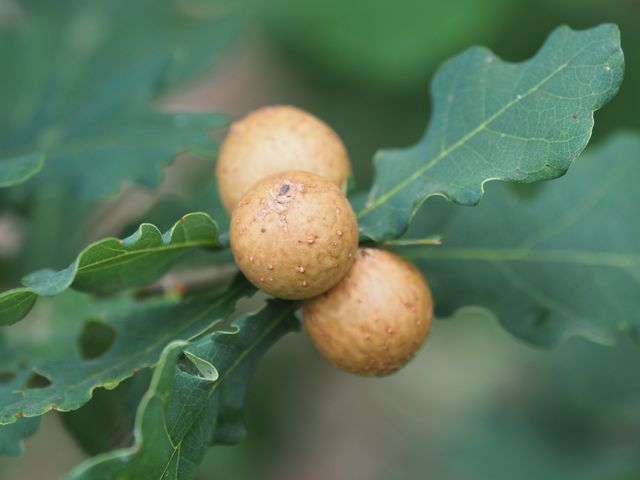
Why do insects make plants grow strange swellings called galls? They make them to protect their larvae and to give them a source of shelter and food.
A gall is a growth on a tree or plant that is created by an insect. They come in many different sizes and shapes an you may have seen one without realizing it wasn’t suppose to be on the plant. Some of them become large balls, and some of them are long, fingerlike protrusions. The word gall comes from the Latin “galla” and means “oak-apple”. They are mostly caused by insects, but they can also be caused by viruses, fungi, and bacteria. We are going to concentrate on insect caused galls today. Interesting fact: the study of plant galls is called cecidology, which comes from the Greek word kekidion, which means something gushing out.
Galls are made by a parasitic insect, but they are almost always not harmful to the tree. The insect makes the tree or plant grow in a different way or direction to benefit the insect, but the tree is only growing a little bit more, so there is no harm there. And sometimes the galls can actually be beneficial. In the case of the grape leaf galls, the gall moves the plant’s stomata, which are the holes they take in carbon dioxide through. This brings stomata to places on the plant where they aren’t usually present and it increases the amount of carbon dioxide the plant can take in, which increases the amount they can photosynthesize. It is beneficial for both the insect and the grape plant. Galls can accidentally damage a plant or tree if there are too many of them in one place. They may increase the weight on that part, which could cause it to break off. A lot of galls might also slow the growth of the tree or plant because it will have to direct growth energy to the gall.
There are several kinds of insects that produce galls. Each type of insect makes a different type of gall on a different type of plant and experts can usually know what type of insect made it by looking at the gall. Some jumping lice, psyllids, some aphids, some adelgids, some phylloxerans, some wasps, some midges, some flies, some moths, some mites, some beetles, and some weevils make galls. There are many different species that make galls, but only a select few insects within each species. And they make a whole range of different galls. Here are some examples. One aphid makes tiny bumplike features all over a grape leaf. A wasp called cynipdae makes galls on the leaves of oak trees and they are a variety of sizes, colors, and shapes. A wasp called trichoteras tubifaciens makes galls that look like little pieces of children’s breakfast cereal stuck all over the leaves of Oregon oak trees. Then there is the urchin gall, which is a small, spiky growth that looks like a pink or red sea urchin, hence its name. It is made by a wasp.
The insect makes the gall as a place to incubate its egg and larvae. The insect lays the egg inside the tree or plant and the tree responds to the injury by growing a lump around it. The larvae is at the center of this lump. It is a perfect place for the larvae because it is warm, it is sheltered from the weather, and it is sheltered from any predators that might eat larvae. It also gives the larvae a source of food until it is big enough to fend for itself. Once the larvae have grown enough, it crawls out from the center of the gall and heads off.
So, how does an insect make a gall? There is a theory, but nobody knows the exact process. Probably, when the insect lays its eggs in developing plant tissue, chemical signals alter the plant’s normal growth. These could be hormones, such as auxins and cytokinins. Auxins help to regulate cell growth and cytokinins stimulate cell division. When these chemical signals interfere with the plant’s growth, they can cause the cells to multiply and grow in unusual patterns, building a structure ar. It is interesting how different species can stimulate different colors and shapes of gall, even on the same tree.
Interestingly, oak galls have been used for centuries to make iron gall ink. It has a high tannin content that reacts with iron salts to produce a dark ink that has long been used to write manuscripts and historical documents. And this is what I learned today.
Sources
https://www.thoughtco.com/what-are-galls-1968384
https://en.wikipedia.org/wiki/Gall
Photo by Anja van der Leij: https://www.pexels.com/photo/close-up-of-oak-marble-galls-on-green-leaves-38974117/