
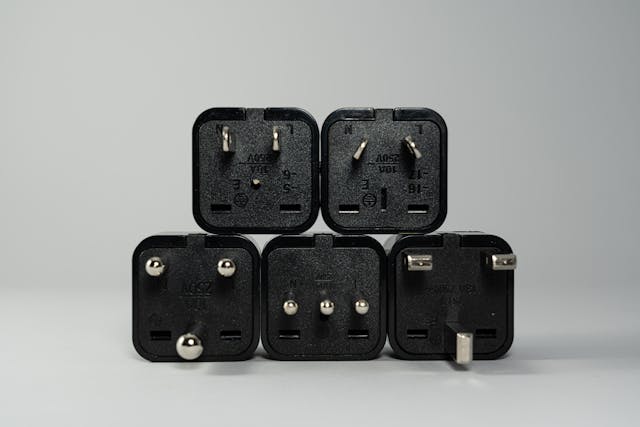
Why are there so many different types of electrical outlets? There are so many different types of electrical outlets because countries built their electrical networks independently, and they all made different choices based on their own technology, traditions, safety rules, and requirements.
There are 15 commonly listed styles of electrical plug and outlet around the world, and they are labeled from Type A to Type O. Type A is used in North and Central America and Japan. It has two flat parallel pins. Type B is similar, but it has a round earth pin as well. Type C is one of the most common types around the world and is used in many European countries. It has two round pins. Types E and F are also used in many parts of Europe, but they are not exactly the same because they handle grounding in different ways. Type G is used in the UK, Ireland, Malaysia, Singapore, and Hong Kong. It has three rectangular pins. Type H is used in Israel. Type I is used in Australia, New Zealand, Papua New Guinea, and Argentina. Type J is used in Switzerland and Liechtenstein. Type K is used in Denmark and Greenland. Type L is used in Italy. Type M is used in South Africa, Eswatini, and Lesotho. Type N is used in Brazil, and Type O is used in Thailand.
So, why is there no standardized outlet? The main reason is that each country built its electrical system independently of the others. By the time international travel and global trade became common enough for this to be annoying, the systems were already installed. Every house, every factory, every appliance, and every repair system had been built around the national standard. Changing all of that would be extremely expensive and very disruptive. Where countries share an outlet type, it is often because of history, trade, or colonial connections. The British Type G plug, for example, is used in the UK and in several countries that were once connected to the British Empire. North America uses the same basic system because the electrical network developed across the continent in a connected way. Japan uses a North American-style plug system, which is why Japanese plugs look so similar to American ones.
The difference is not just the shape of the outlet. It is also whether the plug has an earth connection, and what voltage the electrical system uses. All standard outlets have a live and a neutral connection. When a plug is connected to an outlet, electric current flows in through the live wire, passes through the device being used, and flows back out through the neutral wire. That completes the circuit. However, if there is a fault, the current could flow into the metal body of the device. If a person touched it, the current could pass through their body, which could be extremely dangerous.
This is why many plugs have a third pin, called the earth pin, or ground pin. The earth wire is connected to the body of the device and then to the ground through the building’s wiring system. It provides a low-resistance path for the current. If there is a fault, most of the current flows through the earth wire rather than through a person. Because the resistance is low, a large current flows, which should blow the fuse or trip the breaker. The important thing is not that the earth wire makes electricity harmless. It gives dangerous current a safer path and helps the safety system cut the power.
The voltage difference also comes from history. The USA was one of the first countries to build large electrical networks, starting in the 1880s. Early systems used around 110 volts, partly because lower voltage was seen as safer for electric lighting in homes. If electricity is compared to water, then voltage is like pressure. A higher voltage can push electrical energy more efficiently over distance, but it can also be more dangerous if something goes wrong.
When many European countries developed their systems, they eventually moved toward higher voltages, around 220 to 240 volts. This made it cheaper to deliver the same power because a higher voltage can provide the same amount of power with a lower current. Lower current means less energy is lost as heat in the wires, and the wires do not need to be as thick. That saves money, especially across a large electrical network.
By the time the USA realized the advantages of higher voltage, it was already too late to easily change everything. Homes, appliances, factories, wiring systems, and safety standards had all grown around 110 to 120 volts. Rebuilding the entire system would have cost far too much money. However, the US did not completely stay with only 120 volts. These days, most American homes receive split-phase power. Ordinary outlets provide about 120 volts for everyday devices, while larger appliances such as ovens, electric dryers, water heaters, and air conditioners can use 240 volts.
There will probably never be a single universal outlet because every country has different laws, different safety standards, different voltages, and millions or billions of devices already in use. A universal plug would be convenient for travelers, but it would not be convenient for the countries that had to replace their entire electrical infrastructure. The world is already too invested in the systems it has. That is why a small travel adapter can do what international governments probably never will. And this is what I learned today.
Sources
https://www.iec.ch/world-plugs
https://warrington.ufl.edu/news/why-do-different-countries-have-different-electric-outlet-plugs
https://www.kristechwire.com/electrical-outlets
https://www.bbc.co.uk/bitesize/guides/znvr4xs/revision/2
Image By ARTol – Own work, CC BY-SA 4.0, https://commons.wikimedia.org/w/index.php?curid=123266308
Photo by Castorly Stock : https://www.pexels.com/photo/black-wall-plugs-3639031/