
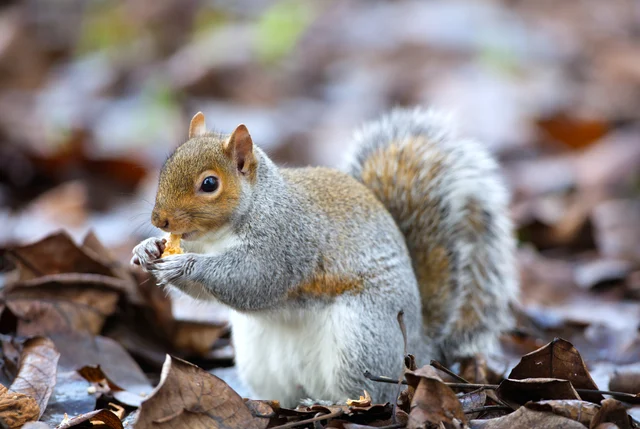
How do squirrels find where they buried their nuts? Squirrels find their buried nuts by using spatial memory, visual landmarks, and their sense of smell. They also bury far more nuts than they need, which is useful because they will not find every single one again.
We imagine squirrels only eating acorns, but they actually have a pretty varied diet. There are roughly 280 species in the squirrel family, and they are not all the same. Most species eat many different kinds of plant material, including fruit, nuts, seeds, buds, flowers, fungi, and bark. They will also eat insects, eggs, and even small animals when the opportunity arises or when food is scarce. Nuts are especially valuable because they are high in fat and protein. They are also easy to carry and easy to store. A nut is basically a little packet of energy, which is exactly what an animal needs when winter is coming.
Squirrels that bury food are using a behavior called caching. There are two main kinds of caching. Some animals are larder hoarders, which means they put a lot of food in one main store. Other animals are scatter hoarders, which means they bury small amounts of food in many different places. Many tree squirrels are scatter hoarders. This is useful because if another animal finds one cache, it only gets one nut. The rest are still hidden somewhere else.
Some squirrels can bury thousands of nuts in a season. They don’t expect to get all of them back. Some will be stolen by other animals. Some will rot. Some will be forgotten. Some will sprout and grow into trees. From the squirrel’s point of view, this doesn’t matter as long as it finds enough of them to survive. From the tree’s point of view, it is a great system because the squirrel is carrying seeds away from the parent tree and planting them.
So, how do squirrels find where they buried their nuts? Their sense of smell helps, but it is not the whole answer. If squirrels only used smell, they would dig up any buried nut they could smell, including nuts hidden by other squirrels. Experiments have shown that squirrels are much better than that. In one study, gray squirrels were allowed to bury nuts. Later, the researchers gave them the chance to search in places where they had hidden nuts and in places where other squirrels had hidden nuts. The squirrels dug up their own cache sites more often than the other cache sites. That means they were not just sniffing randomly. They remembered where their own nuts were.
More than smell, squirrels rely on landmarks and spatial memory. A squirrel’s home range is not usually a completely unknown wilderness. It is an area the squirrel knows very well. It knows the trees, walls, rocks, paths, fences, and patches of ground. When it buries a nut, it can remember the location in relation to those landmarks. It might not remember the location in words, obviously, but it can build a kind of mental map. That tree, that fence post, that patch of soil, and that distance from the path all become clues.
This is why squirrels can take different routes and still find their caches. They are not simply following a smell trail back to the exact place. They are navigating. They also revisit cache areas and sometimes move nuts to new places, especially if they think another animal has seen them hiding food. Squirrels have even been seen pretending to bury food when they are being watched, which suggests they are also thinking about thieves.
Squirrels may also organize their memories by grouping similar things together. Studies on fox squirrels have shown that they can bury different types of nuts in different areas. This is a memory strategy called chunking. Humans do something similar when remembering phone numbers. A long string of numbers is hard to remember, so it is broken into smaller groups. 0123456789 becomes 00123 456 789. Squirrels may be doing something similar with food. Instead of remembering every nut as a completely separate item, they may organize their caches by type, quality, or value. The almonds are over there. The walnuts are over here. The less valuable nuts are somewhere else. That makes the mental map easier to manage.
As an interesting extra piece of squirrel information, squirrels are unusually good at running head first down trees. Many climbing mammals prefer to come down with their heads up, but squirrels can descend head first because they can rotate their hind feet. Their sharp claws dig into the bark when they climb. If their feet could not turn, running down a tree would pull the claws away from the bark and the squirrel would fall. Instead, squirrels can turn their back feet almost 180 degrees, so the claws still point into the tree and support their weight. This lets them run quickly up and down trunks, which is useful when escaping predators or racing to a food source.
Squirrels look as if they are randomly digging holes and forgetting things, but they are actually managing a complicated food storage system. They use smell, landmarks, memory, organization, and probably a little overpreparation. They bury more than they need because winter is risky, theft is common, and memory is not perfect. The nuts they forget are not wasted, though. Many of them become the next generation of trees. And this is what I learned today.
Sources
https://www.discoverwildlife.com/animal-facts/mammals/how-squirrels-find-their-nuts
https://www.scientificamerican.com/article/do-squirrels-remember-where-they-buried-their-nuts
https://www.lovethegarden.com/uk-en/article/what-do-squirrels-eat
https://en.wikipedia.org/wiki/Squirrel
Photo by DANNIEL CORBIT: https://www.pexels.com/photo/close-up-of-a-grey-squirrel-eating-in-autumn-35321058/