
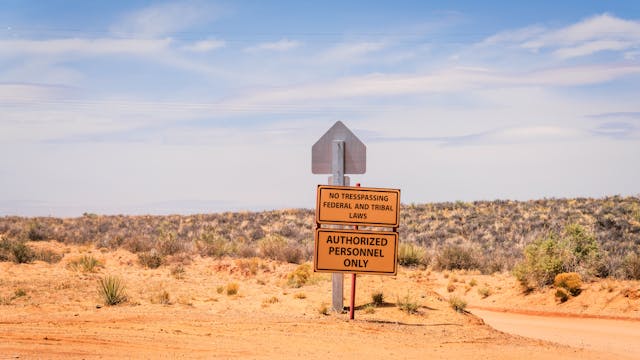
Why is it called Area 51? The simple answer is that it was a map designation, but the exact reason why that number was chosen is not completely clear. The site at Groom Lake was near the Atomic Energy Commission’s Nevada Proving Ground, where nuclear testing was carried out. The land there was divided into numbered areas, and the strip of desert that became famous as Area 51 appears to have taken its name from that system. It was also called Watertown, Paradise Ranch, the Ranch, Groom Lake, Dreamland, and later Homey Airport.
Area 51 is in the Nevada desert, about 40 km south of the tiny town of Rachel, Nevada. It sits beside Groom Lake, a large, flat, dry lakebed. That flatness is one of the main reasons the place was useful. During World War 2, the area was used as an aerial gunnery range, and there was already an old airstrip near the salt flat. If you look at satellite images today, you can still see the runways and the huge pale shape of Groom Lake in the desert.
The area might have remained an almost forgotten piece of military land if the CIA had not needed somewhere extremely remote in the early Cold War. At that time, the United States was trying to develop spy planes that could fly higher than ordinary aircraft. These planes could stay above most danger and take photographs of Soviet military sites. Satellites can do that job now, but in the 1950s the spy satellite age had not really arrived, and aircraft were still very important.
The main plane the CIA needed to hide was the U-2. It was not invisible to radar, but it could fly so high that enemy fighters and missiles could not easily reach it at first. Richard Bissell, a senior CIA official, was involved in finding a place where the U-2 could be tested and pilots could be trained in secret. A group from the U-2 project flew over the Nevada desert and spotted the old strip beside Groom Lake. It was remote, flat, dry, and surrounded by restricted land. It was almost perfect.
There was one problem. Groom Lake was near the Atomic Energy Commission’s proving ground, but it was not actually part of it. The CIA asked the Atomic Energy Commission to add the area to its Nevada holdings, and President Eisenhower approved the arrangement. The Atomic Energy Commission had been set up after World War 2 to “foster and control the peacetime development of atomic science and technology”. One of the jobs they had was to manage nuclear testing across the US. After World War 2, there were hundreds of nuclear tests carried out on US land. The majority of those were in open deserts, such as the one in Nevada. The Atomic Energy Commission divided up the land that had been used in Nevada in Areas. The Areas they created go from Area 1 to Area 30 and each one contains between zero and 266 nuclear tests (Area 3). The Atomic Energy Commission designated the CIA’s land as Area 51, presumably because they never thought they would get as high as 51 nuclear test site areas.
Lockheed’s engineer Kelly Johnson gave the place a more attractive name, Paradise Ranch, because asking people to work in a place called Area 51 in the middle of the desert probably didn’t sound very appealing. The name was shortened to the Ranch, and people who worked there were sometimes called ranch hands.
Area 51 began its modern life as a secret testing site in 1955. The first U-2 accidentally became airborne during a taxi test there on August 1, 1955, and the first official test flight came a few days later. After that, Groom Lake became an important place for testing secret aircraft. The A-12 OXCART, which was the CIA’s very fast successor to the U-2, first flew there in 1962. It could fly at over Mach 3 and reach altitudes far above normal aircraft. Later, other secret aircraft were tested there as well, including stealth aircraft such as the F-117 Nighthawk.
So, why did Area 51 become as famous as it has? The obvious answer is aliens, but the real answer is secrecy. The CIA and the Air Force went to great lengths to hide what they were doing. The planes being tested there were far ahead of normal aircraft at the time. They flew higher, faster, and sometimes looked very different. When people saw strange lights or strange shapes in the sky, it was easy to imagine something from another world. And when the government refused to explain anything, the mystery grew.
That does not mean there was no conspiracy at all. There was definitely secrecy. There were cover stories. There were crashes of experimental aircraft. There were people told not to talk. The government really was hiding something, but what it was hiding was advanced aircraft technology, not alien bodies and flying saucers. The secrecy that was necessary for spy planes created exactly the kind of atmosphere in which alien stories could grow.
The U.S. government publicly acknowledged Area 51 much later than most people would expect. A heavily redacted CIA history of the U-2 program had been released in 1998, but the clearer public acknowledgment of Area 51 came in 2013, when more documents were declassified. Those documents confirmed the role of Groom Lake in testing aircraft such as the U-2 and the A-12. They did not confirm the existence of aliens.
Area 51 is still heavily guarded and closed to the public. That does not prove there are aliens there. It only proves that the United States government still has things it does not want people to see. That probably means aircraft, weapons, sensors, drones, or other military technology. If aliens had managed to cross the absolutely mind-boggling distances between stars, the chances of them reaching Earth and then crashing in a desert in Nevada are probably pretty slim. And this is what I learned today.
Sources
https://edition.cnn.com/us/area-51-fast-facts
https://en.wikipedia.org/wiki/Area_51
https://en.wikipedia.org/wiki/Nevada_Test_Site
https://en.wikipedia.org/wiki/United_States_Atomic_Energy_Commission
https://www.dictionary.com/articles/area-51
https://en.wikipedia.org/wiki/Lockheed_U-2
https://en.wikipedia.org/wiki/Lockheed_A-12
Photo by Abhishek Navlakha : https://www.pexels.com/photo/desert-landscape-with-no-trespassing-sign-in-arizona-33132626/