
How did Wilhelm Röntgen discover X-rays? He discovered that when he turned on a high-voltage electrical current in a cathode-ray tube, a nearby screen coated with barium platinocyanide began to glow with a green, fluorescent light.
Wilhelm Röntgen was a German experimental physicist. He was born in Lennep, which was in Prussia at the time, but is now in Germany, in 1845. He was expelled from his school in 1865 when he was accused of drawing a caricature of one of his teachers, even though it had been drawn by someone else. Because of this, he didn’t receive his diploma, and local universities wouldn’t accept him. He ended up moving to Switzerland and received his Ph.D. from the University of Zurich. He was also stateless for the first 40 years of his life because his family relinquished their Prussian status when he was three. He finally received German citizenship in 1888.
After graduating from the University of Zurich, he became a professor at the University of Strasbourg, then at the University of Giessen. He became the chair of physics at the University of Würzburg, and it was here that he would discover X-rays.
Röntgen was an experimental physicist, and when he discovered X-rays, he was experimenting with cathode ray tubes. A cathode ray tube is a glass vacuum chamber that uses a high voltage to fire a stream of electrons from one end to the other. When the electrons hit the glass at the other end of the tube, they impart energy to the glass, and the glass molecules absorb that energy and then release it as light. Cathode ray tubes had been invented in the mid 19th century, but it had only become possible to make them almost perfect vacuums in the 1870s. Interestingly, the electrons that cause the glow wouldn’t be discovered until 1897.
These are the cathode ray tubes that Röntgen was experimenting with in 1895. He wanted to investigate the behavior of the cathode rays and see what kind of effects could occur outside of the cathode ray tube. To make sure that the glow from the tube wouldn’t confuse his observations, he wrapped the cathode ray tube in cardboard. He switched the lights off and checked that no light was escaping the tube. When he switched the cathode ray tube on, he noticed a glow from a nearby screen that was coated with barium platinocyanide. Barium platinocyanide is a fluorescent material, which means that when high energy radiation hits it, the energy is absorbed by electrons in the material. When these electrons release their energy, they do so as light. Röntgen checked the cardboard around the tube, and no light was escaping. Every time he switched the tube on, the screen began to glow.
Röntgen realized that something was coming out of the tube, through its glass, and hitting the screen. He called them X-rays because X meant unknown, and they left shadows like light, so rays. Then, because he was an experimental physicist, he started to experiment. He tried putting different things between the tube and the screen to see if anything could block these rays. Paper didn’t stop it. Neither did thick books or wood. Some metals reduced it more than others, and lead stopped it. Then, in a moment that would change the course of medicine and our world, he put his hand in front of it. The strange rays passed through his hand but were absorbed and blocked more strongly by the bones. On the screen, he could see the shadow of his own bones. This was a marvelous moment in history. Röntgen was the first person in the world to see inside the human body without cutting it open.
The X-rays are released because the electrons are accelerated to very high speeds through the cathode ray tube, and when they hit the glass at the end, they are decelerated violently. This produces a lot of high energy electromagnetic radiation, which are X-rays. Röntgen didn’t know what caused them.
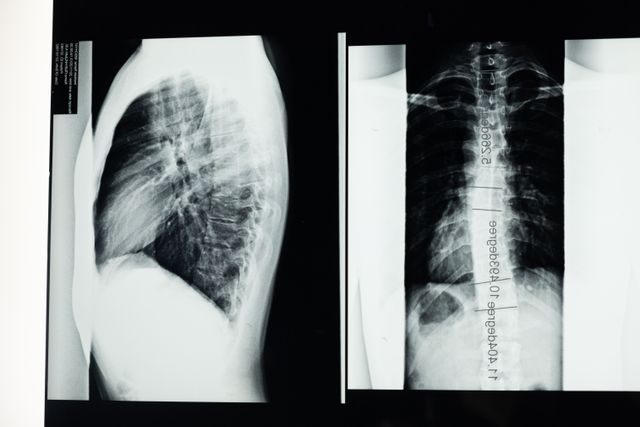
About 6 weeks after making this discovery, Röntgen took the first X-ray image in history. He took an image of his wife’s hand. Her bones and her wedding ring were clear on the image. He published his discovery on 28 December 1895. The scientific and medical worlds were very quick to recognize the importance of the discovery, and within 2 months, X-rays were being used in a hospital to view a fracture in a patient’s leg. The rest is history.
Röntgen was awarded the Nobel Prize in Physics in 1901, but he was not interested in fame and fortune. He donated all of the prize money to his university and never took out any patents on his discovery, allowing it to be used freely. Unfortunately, at the time of his death, he was nearly bankrupt following the inflation that hit Germany after World War I. And this is what I learned today.
Sources
https://www.aps.org/apsnews/2001/11/1895-roentgens-discovery-xrays
https://en.wikipedia.org/wiki/Wilhelm_R%C3%B6ntgen
https://en.wikipedia.org/wiki/Cathode_ray
Photo by cottonbro studio: https://www.pexels.com/photo/x-ray-images-of-the-spine-5723884/