
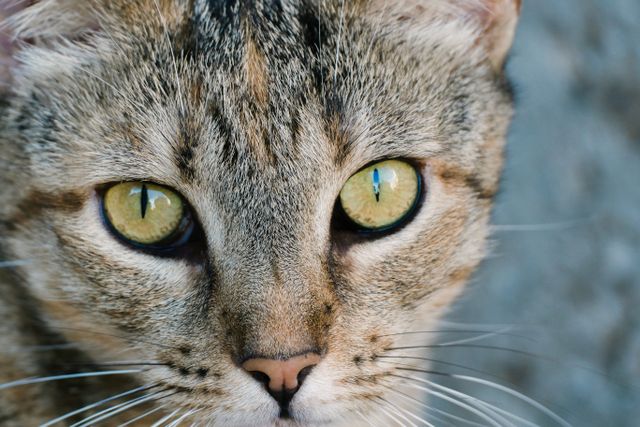
Why do cats have vertical pupils, but lions don’t? Cats have vertical pupils and lions don’t because of the different ways that they hunt.
If you have ever looked at your cat, you will have noticed that it has vertical slit pupils. Cats are not the only animals that have vertical pupils. They can be found in foxes, venomous snakes, crocodiles, and geckos. Lions have round pupils, the same as us. However, round and vertical pupils are not the only kinds of pupils. You can also find W shaped pupils in cuttlefish, crescent pupils in manta rays and dolphins, pupils that look like a string of pearls in some geckos, horizontal split pupils in toads, and horizontal pupils in donkeys. There are many different ways eyes have evolved in response to the conditions that animals live in.
What are pupils for? The pupil is a hole in the front of the eye that is surrounded by the iris, which is the colored part of the eye. It is behind the cornea and in front of the lens. When light enters the eye, it passes through the cornea first, which bends the light to focus it. The cornea is a fixed focus lens and can’t be moved as the lens can. The light then passes through the pupil, which can be widened or narrowed to let in more or less light. The light then travels through the lens, which can be flexed by muscles to focus the light, and lands on the retina at the back of the eye. The retina has rods and cones, which are stimulated by the light that falls on them, and they send information up the optic nerve that tells the brain what we are looking at. The pupil’s job is to prevent too much light from getting into the eye when it is very bright or allowing more light in when it is dark. It also helps the eye focus on near and distant objects.
So, why do cats, snakes, and some other animals have vertical slit pupils? It comes down to the way they hunt. Cats are ambush hunters. This means they keep low to the ground and stalk their prey before attacking it at the most opportune moment. They also track fairly small prey and need to be able to rapidly see movement and judge distance accurately. If they jump too far, they’ll miss their prey. A split vertical pupil helps them with that. Any animal with two forward facing eyes can judge distance using stereopsis. Your left eye and right eye are separated, so each one sees a slightly different image, and your brain can compare the two to calculate a distance. We also use something called defocus blur, which means objects at different distances from the point we are focusing on are blurred, and the amount of blur gives us information about how far away something is. The vertical slit pupil in a cat’s eye keeps vertical edges fairly sharp, so the cat can use stereopsis. But because the slit is taller than it is wide, horizontal edges become blurred more strongly when they are out of focus. What does that mean? When the cat is low to the ground and hunting a bird, the vertical lines of the bird are clear and the cat can judge how far away it is, but the horizontal features on the ground are blurred more sharply, giving a lot of information about how far away the bird is. Many animals that hunt close to the ground have vertical slit pupils because small errors in distance can make a difference between catching prey or missing it. Vertical slit pupils have another advantage. They can close to a very narrow slit in bright sunlight and open to an almost circular shape in the dark. This gives cats much greater control over the amount of light entering their eyes than we have with our round pupils.
Lions don’t need vertical slit pupils because they are taller, which reduces the advantage of being able to see blurs on the ground. And they hunt by chasing their prey, which means they need a wider field of vision and greater depth of field to judge distances from further away.
Other animals have different shaped pupils for a variety of reasons. Donkeys, cows, and many other grazing prey animals have eyes on the sides of their heads, and they have horizontal pupils. These horizontal pupils give them a panoramic view so they can see predators approaching. Interestingly, to be able to see, these pupils need to always be parallel with the ground. When horses and sheep dip their heads to graze, they rotate their eyeball in the socket to keep it parallel with the horizon.
Dolphins and many animals that live in the sea have crescent pupils. In fact, dolphins are able to change the shape of their pupil. They can go from a very large round pupil, down to a crescent pupil, and then almost close it except for two small holes. They have this ability because they need to be able to see both underwater and above the water. There is a huge difference in the amount of light, so they can let more light in when they are deep down and keep most of it out when they are on the surface. The two tiny openings may also help dolphins focus when they look above the water, because light bends differently in air and water. And that is what I learned today.
Sources
https://naturalwonders.substack.com/p/why-do-cats-have-vertical-pupils
https://www.sciencefocus.com/nature/why-do-cats-and-snakes-have-slits-for-pupils
Photo by Ramon Karolan: https://www.pexels.com/photo/close-up-portrait-of-a-tabby-cat-s-eyes-33676335/